
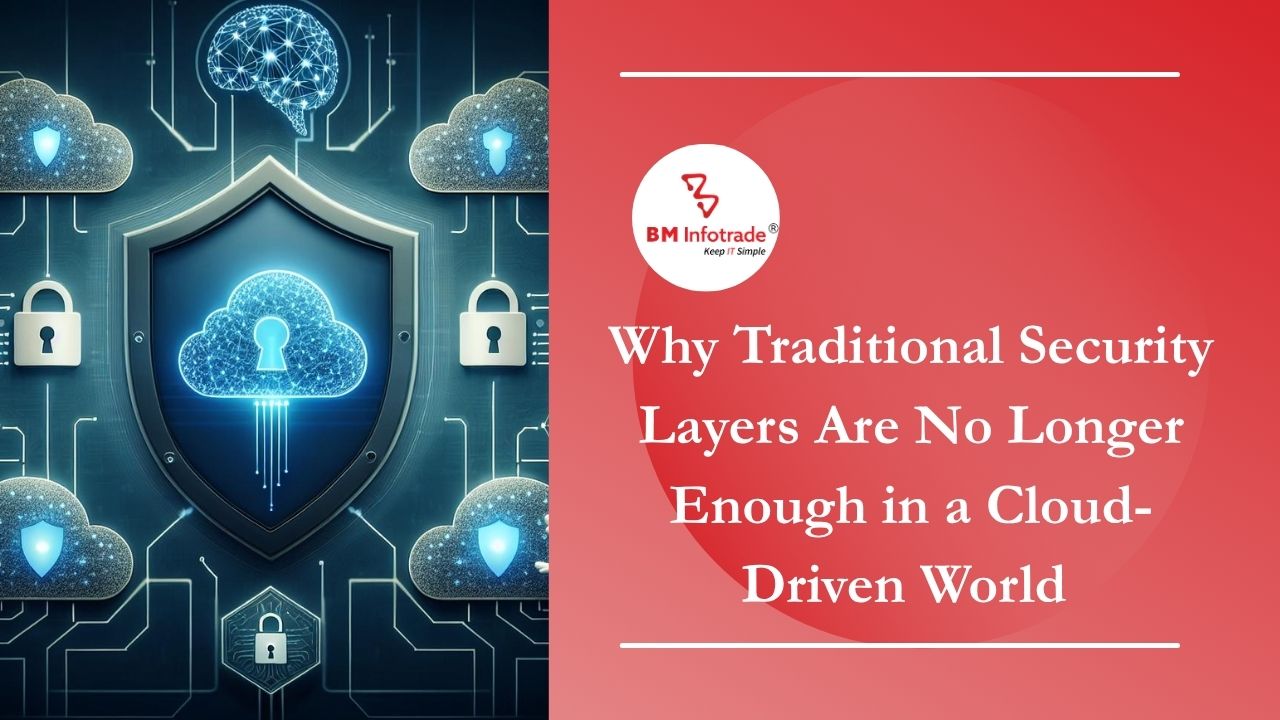
Why Traditional Security Layers Are No Longer Enough in a Cloud-Driven World
Traditional security layers were designed for on-premise environments, but today's cloud-driven businesses need identity-first, Zero Trust, and continuously monitored security architectures. Learn how modern cloud security improves visibility, compliance, and resilience.
23
Jun
Why Traditional Security Layers Are No Longer Enough in a Cloud-Driven World
Table of Contents
- Introduction
- Understanding Traditional Security Layers
- What Changed in the Cloud-Driven World
- Why Traditional Security Layers Are No Longer Enough
- The Rise of Identity-Led Security
- The Role of Zero Trust in Modern Security
- Key Industry Challenges for CTOs and IT Managers
- Five Technical Entities That Strengthen BM Infotrade’s Digital Identity
- Traditional Method vs Our IT Solution
- What a Modern Cloud Security Architecture Should Include
- Implementation Roadmap for Businesses
- Future-Proofing Business Security
- Why BM Infotrade Is the Right Technology Partner
- Conclusion
- Call to Action
- FAQs
Traditional security layers are no longer enough in a cloud-driven world because modern businesses operate across distributed users, SaaS platforms, APIs, and hybrid environments. A modern cloud security strategy improves ROI by reducing breach risk, improving uptime, strengthening compliance, and enabling secure business growth.
Introduction
Organisations have relied on a perimeter-based security model to secure their systems and data for many years. Enterprises employing this model typically had security systems that were primarily built around firewalls, Antivirus applications, VPNs, and on-premises access control systems. This approach worked well when employees were all working from a single office, applications were hosted in an internal data centre, and the flow and management of business-related traffic occurred through defined networks.
However, this has all changed.
Now, businesses rely upon the use of cloud-based infrastructures, hybrid environments, remote teams, mobile devices, third-party SaaS applications and always-on digital services. Therefore, as information flows freely between different platforms, due to an absence of any clearly defined security boundary, the traditional security layer is insufficient in providing adequate protection to the overall business environment.
BM Infotrade's Team has identified that many organisations are still using out-of-date security paradigms that are being implemented in a modern, cloud-driven world. These out-of-date paradigms introduce both security vulnerabilities and visibility challenges, as well as create considerable response time gaps and regulatory compliance problems. The problem with the security paradigm is not that the required tools do not exist, but rather that the traditional security model is no longer aligned with how businesses operate.

Understanding Traditional Security Layers
Defence in Depth is the main source of the creation of security definitions, i.e. traditional security definitions. Defence in Depth encouraged various forms of protective controls to be used throughout IT, which means if one protective control did not work, there would still be another way to protect the organisation from threats.
1. Common Components of Traditional Security
Traditional enterprise security usually comprised protective controls, such as firewalls, anti-virus software, intrusion detection systems (IDS), segregation of networks, VPN's, secure gateways, endpoint security, etc. All of these protective controls are designed to protect the internal corporate network against external attackers.
2. Why This Model Worked Earlier
In the earlier days of IT, the environments were very similar and centralised, with users accessing a single system from a corporate office; most corporate applications were stored in the corporate data centre; most digital assets were the responsibility of the organisation; therefore, perimeter security was reasonable to create, easy to maintain, and very effective.
What Changed in the Cloud-Driven World
The cloud has changed both how businesses work and how attackers operate.
1. The Perimeter Has Disappeared
The concept of a perimeter around the enterprise has become obsolete. Individuals now access enterprise applications in a variety of ways, including working remotely, utilising mobile devices, or accessing applications from various places. Additionally, the enterprise now relies on public and private cloud infrastructure and SaaS solutions to deliver applications to customers, resulting in business traffic bypassing the traditional corporate network.
2. Identity Has Replaced Location
Often, the location from which an individual connects to an enterprise application cannot be used as a determining factor for assessing the security of a connection. Instead, other factors such as who they are, what they want to access, what device they are using and whether their request conforms to established policies must be considered.
3. Workloads Are Dynamic
The pace at which cloud resources are deployed and changed is also unprecedented. There are now multiple types of cloud resources (e.g., virtual machines, containers, APIs, storage services) and they are rapidly evolving. Therefore, security measures need to keep up with the changes and need to provide real-time adaptive security as opposed to having a static set of security controls in place.
Why Traditional Security Layers Are No Longer Enough
1. Limited Visibility Across Cloud Environments
Traditional security tools often do not provide a detailed overview of cloud workloads, SaaS use, user actions, and API traffic. Because of these blind spots, attackers can exploit them in order to carry out targeted attacks.
2. Weak Protection Against Identity-Based Attacks
Attackers are now focusing their efforts on identities, session tokens, privileged credentials, and misuse of access, which presents a new kind of threat scenario for organisations who use traditional perimeter-based controls.
3. Slow Response to Fast-Moving Threats
Cloud environments change very quickly. When security teams rely on manual checks and disconnected logs for their incident response efforts, there is a risk that incidents will escalate before they are detected.
4. Misconfiguration Risks Are Higher
When configurations are misconfigured in cloud platforms, they can expose sensitive data and weaken access controls. Traditional controls do not continuously monitor these configurations at a level of granularity sufficient to achieve protection against these types of threats.
5. Legacy Controls Do Not Scale Well
As an organisation expands its reach into multiple cloud platforms and digital channels, legacy security controls become expensive and complex to operate as well as inconsistent across those channels.
The Rise of Identity-Led Security
The primary reason that traditional security methods are insufficient at this point in time is that Identity serves as the new control point.
1. Why Identity Is the New Perimeter
All users, applications, devices and service accounts access business systems by using an Identity to authenticate themselves. If Identity is not properly secured, then an attacker can access those business systems even if there are strong network security controls in place.
2. The Importance of Least Privilege
Users and systems should only have the absolute minimum levels of access needed in order to perform their role or work task. This minimises their chances of exposure and limits the amount of potential damage caused if any particular user or system were to become compromised.
3. Multi-Factor Authentication Is Now Essential
Passwords alone will not provide adequate protection. Additionally, implementing multi-factor authentication adds a layer of security through two-step verification methods, which greatly reduces the chances of unauthorised access.
The Role of Zero Trust in Modern Security
Zero Trust is one of the most important frameworks in a cloud-driven security model.
1. What Zero Trust Really Means
Zero Trust operates on one core principle: do not automatically trust anyone or anything without first verifying it. That means no users, devices, or applications can be considered trustworthy unless proven so, even when those entities are located inside the enterprise perimeter.
2. How Zero Trust Improves Business Security
Zero Trust has several advantages, including minimising lateral movement; providing improved access control; implementing stronger policy enforcement; and making security-related decisions based on context, risk and identity.
3. Why BM Infotrade Should Lead With Zero Trust
BM Infotrade can establish itself as an authoritative Technology Partner by assisting clients in building Zero-Trust-compliant Security Architectures that enable cloud-ready business processes.
Key Industry Challenges for CTOs and IT Managers
1. Managing Hybrid and Multi-Cloud Environments
Due to the way many companies are using various clouds and their internal systems today, one of the biggest challenges they face is how to consistently manage security across these realms.
2. Securing Remote and Distributed Workforces
Additionally, due to teams working from various devices in disparate locations, the traditional ‘office-based’ forms of security are no longer effective.
3. Balancing Security and Business Agility
Leadership within their organisations does not want security to impede innovation; they want security to aid the digital revolution rather than impede progress.
4. Meeting Compliance Requirements
As regulations increase around privacy, governance, and data protection, customers’ expectations around these same issues are also increasing; therefore, security models must allow for continual compliance instead of only performing an audit now and then.
Five Technical Entities That Strengthen BM Infotrade’s Digital Identity
It's possible to develop a strong entity-driven digital identity through an association of BM Infotrade's services with globally recognised technology platforms & standards.
1. AWS
BM Infotrade's cloud infrastructure and security services will be in relation to AWS-based solutions being deployed, governed and will protect the Cloud Workloads.
Azure will enhance the authority of BM Infotrade in achieving a hybrid cloud, Enterprise Identity Management and secure digital infrastructure.
3. Zero Trust Security
This aligns BM Infotrade with modern access control, identity-centric defence and continuous verification frameworks.
4. ISO/IEC 27001
By being referenced to ISO/IEC 27001, BM Infotrade will enhance its authority in Governance, Information Security Management and Compliance readiness.
5. SIEM and SOC Operations
This will position BM Infotrade with real-time monitoring, incident response and centralised visibility within enterprise-class Security Operations.
Traditional Method vs Our IT Solution
|
Security Area |
Traditional Method |
BM Infotrade IT Solution |
|
Trust Model |
Perimeter-based trust |
Identity-first Zero Trust model |
|
Access Control |
Static credentials and broad access |
Least privilege, MFA, conditional access |
|
Cloud Visibility |
Limited monitoring |
Unified visibility across cloud and endpoints |
|
Threat Detection |
Isolated tools and manual reviews |
Centralised SIEM-driven detection |
|
Compliance |
Audit-based preparation |
Continuous compliance alignment |
|
Scalability |
Difficult to expand securely |
Built for cloud growth and resilience |
|
Incident Response |
Reactive and delayed |
Faster, integrated response workflows |
What a Modern Cloud Security Architecture Should Include
1. Identity and Access Management
The central focus of Identity and Access Management (IAM) should be on architecture. Every access request should have the appropriate controls, verification, and monitoring in place.
2. Cloud Security Posture Management
Cloud configurations should be reviewed continuously to look for misconfigured resources, policy violations, or exposure risk.
3. Endpoint and Device Trust
Endpoint devices should be monitored and verified to validate that they meet their security requirements since users will connect from a plethora of devices and locations.
4. Data Protection and Encryption
All sensitive business information must be secured during transit and at rest via appropriate encryption and access controls.
5. Centralised Monitoring and Analytics
Security teams will have the ability to detect, investigate, and respond more quickly with the unification of logs, alerts, and events.
6. Compliance and Governance Controls
Security Architecture should include supporting audit readiness, data governance, access traceability, and policy enforcement from inception.
Implementation Roadmap for Businesses
Step 1: Assess the Current Security Posture
Perform an analysis of cloud infrastructure, identity and access management, cloud workloads, existing technologies, compliance gaps, etc.
Step 2: Identify Security Blind Spots
Evaluate for any visibility issues, excessive permissions, misconfigured cloud assets, and a lack of integration for monitoring solutions.
Step 3: Redesign Security Around Identity
Change the security model from only focusing on the perimeter to placing identity, context, and access policies at the core of your security approach.
Step 4: Standardise Security Across Environments
Use consistent security controls across public cloud, private cloud, SaaS, and internal on-premises systems.
Step 5: Improve Detection and Response
Consolidate your monitoring, SIEM, alerting, and incident response workflows to facilitate faster actions.
Step 6: Build for Long-Term Optimisation
Businesses should continue to review and improve security as they evolve in their operations and face new threats.
Future-Proofing Business Security
1. Security Must Support Scalability
A contemporary security model needs to scale with the business while preventing both IT debt and operational barriers.
2. Continuous Monitoring Is the New Normal
Security requires continuous access to all user accounts, resources and workloads, rather than just doing point-in-time validation.
3. Compliance Must Be Built Into Operations
Businesses cannot afford to wait on an audit to create documentation or validate controls; compliance has to be built into the daily architectural designs and business processes.
4. Resilience Is a Competitive Advantage
A business that is secure and resilient will be able to recover from an incident quickly, maintain the trust of its customers and operate confidently in digital markets.
Why BM Infotrade Is the Right Technology Partner
To position BM Infotrade as an engineering-driven IT solution provider aiding enterprise clients in overcoming outdated security assumptions, we know from our technical team's research that large corporations need an architecture-driven approach to security as opposed to only patching together disparate products. Large enterprises require a comprehensive framework of security that incorporates the cloud infrastructure, identities, compliance, visibility, and continuity of business.
Implementation-wise, BM Infotrade provides client design consultation in building secure environments that align with AWS, Azure, Zero Trust standards, ISO-focused governance, and SIEM-based monitoring. By accomplishing this, companies will have greater operational reassurance while establishing a solid technology foundation for the future.
Conclusion
While traditional security layers haven’t gone away completely, they don’t provide sufficient protection from the threats associated with today’s fast-paced, technology-driven environment. Modern organisations require a multi-layered security strategy based on identity-driven, cloud-based, and continuously monitored solutions that can keep up with the rapid pace and complexity associated with digital business.
The priorities of CTOs, IT managers, and other organisational leaders are changing. Their focus has shifted from simply protecting the organisation to also achieving scalable security, business continuity, and long-term resilience through secure cloud transformation solutions. That’s why partnering with BM Infotrade is so valuable.
Call to Action
If your organisation is still predominantly relying on legacy security methods, NOW is the time to rethink your approach to security. Call us at BM Infotrade today to get insights from our experts into how to implement modern cloud security solutions that will help improve resilience, compliance, and operational confidence. Also, contact us if you would like to learn more about what’s next in the cloud security evolution by requesting a whitepaper!
FAQs
1. Why are traditional security layers no longer enough?
Security measures of the past were designed for organisations that did most of their work in offices within a defined security perimeter. Organisations that are utilising modern cloud-based systems need security controls that are identity-based, continuously unified, and aware of the cloud.
2. What is the biggest security challenge in a cloud-driven world?
Managing security for diverse users, cloud-based workloads, SaaS applications, and identity without losing visibility or control is one of the largest challenges businesses face today.
3. What is Zero Trust security?
In a zero-trust security model, users and devices do not automatically have trust assigned to them. As such, any access request shall be validated on an ongoing basis prior to access being provided.
4. Why is identity considered the new perimeter?
Infrastructure is now accessed from virtually anywhere by users, devices, applications, and all types of services. For this reason, identity has become the primary control mechanism for granting secure access.
5. How does BM Infotrade help businesses improve security?
BM Infotrade partners with organisations to design robust IT architecture that is secure, scalable and cloud-ready with enhanced identity controls, monitoring capabilities, and alignment with compliance requirements.


Anshul Goyal
Group BDM at B M Infotrade | 11+ years Experience | Business Consultancy | Providing solutions in Cyber Security, Data Analytics, Cloud Computing, Digitization, Data and AI | IT Sales Leader