
Hybrid IT Infrastructure: Bridging On-Premise Systems and Cloud Solutions
Hybrid IT infrastructure enables businesses to combine on-premise systems with cloud platforms for improved security, scalability, performance, and operational flexibility. Learn how BM Infotrade helps organizations build secure and future-ready hybrid environments.
22
Jun
Hybrid IT Infrastructure: Bridging On-Premise Systems and Cloud Solutions
Table of Contents
- Introduction
- Why Hybrid IT Infrastructure Matters for Modern Businesses
- The Current Industry Challenge
- What Is Hybrid IT Infrastructure?
- The Entity-Based Digital Identity Behind a Strong Hybrid IT Strategy
- Key Technical Entities Supporting Hybrid IT Delivery
- How BM Infotrade Bridges On-Premise and Cloud Solutions
- Traditional Method vs. Our IT Solution
- Reference Hybrid IT Architecture
- Implementation Roadmap for Hybrid IT Infrastructure
- Business Benefits of Hybrid IT Infrastructure
- How BM Infotrade Adds Strategic Value
- How to Future-Proof the Business with Hybrid IT
- Success Checklist
- Conclusion
- Call to Action
- FAQs
A hybrid IT infrastructure, which combines both on-premise and cloud-based infrastructure, allows organisations to create a flexible, secure, and scalable operating model. Organisations can leverage existing investments to provide better uptime, keep sensitive workloads under control, and obtain the agility necessary to support growth, compliance, and accelerate their digital transformation initiatives.
Introduction
Today’s enterprise environment does not allow an organisation to pick and choose between its legacy infrastructure solutions and its cloud-based innovations while assuming they operate within different environments. Most organisations currently operate their mission-critical workloads from on-premise servers, local databases, private networks, and business applications that have been built over the years. Simultaneously, they are also experiencing increased demand for speed of service, scalability, analytical capabilities, remote access, and modern applications and delivery models, which push them to adopt cloud solutions. This is what transforms hybrid IT infrastructure from a technology trend into a legitimate business solution.
The technical staff at BM Infotrade agrees that your company doesn't need to eliminate its core on-premise environment in order to move forward. The smarter option is to connect your current infrastructure with new cloud solutions so that both sides work together to enhance performance, increase security, and build a future-ready infrastructure. Hybrid IT is not about having two separate and unconnected systems; it is about creating one shared operating model where all workloads can be deployed in the optimum location, with the purpose behind the placement of each workload in mind.
For Chief Technology Officers (CTOs), IT Managers, Operations Heads and Business Leaders, the question is not whether or not a hybrid infrastructure is relevant. Instead, the question really is, how do we implement this type of environment without increasing complexity, introducing security vulnerabilities, or increasing operational overhead? This is why an engineering-based, structured approach to the implementation of hybrid IT is essential.

Why Hybrid IT Infrastructure Matters for Modern Businesses
While there are many good reasons why many businesses continue to use on-site systems to house their sensitive data, meet compliance, maintain low-latency operations, rely on legacy applications, or have invested in existing equipment, the on-premise technology environment often does not provide the scalability and flexibility that is available with cloud-based platforms.
Cloud solutions provide such advantages as: faster provisioning, elastic computing power, better options for disaster recovery, and easier access to advanced services, which may be able to include automated processes, backup orchestration, identity management and analytics. However, moving all systems to the cloud is not always practical, cost-effective, or risk-free.
The hybrid IT infrastructure can help bridge that gap. A hybrid IT environment allows organisations to retain their critical business systems on site while utilising cloud resources for back-up purposes, workload bursting, collaboration, application modernisation, test/service environments and business continuity. In terms of implementation, the hybrid model can help to lessen disruption while concurrently facilitating innovation.
For BM Infotrade, hybrid infrastructure is not viewed as a compromise. It is significant for BM Infotrade to present it as a smart alignment between performance, compliance, cost containment, and long-term scalability for their business organisation.
The Current Industry Challenge
1. Legacy Systems Still Power Core Business Operations
Businesses utilise ERP systems, file servers, internal apps, and databases integrated into their daily operations. The cost and risk of replacing them overnight are substantial, and many areas of such systems include years of corporate logic, custom workflows, and dependencies on operations.
2. Cloud Adoption Has Created New Complexity
When different departments use SaaS solutions, cloud storage, or hosted applications independently from each other, IT environments become disjointed. When businesses do not have the proper governance for their IT systems, multiple identity systems will be created, security controls will be inconsistent, and the flow of data will not be clear, causing limited visibility of the overall infrastructure.
3. Security and Compliance Expectations Are Higher Than Ever
With the ongoing pressure for businesses to secure sensitive data, maintain uptime, control access and provide proof of compliance, the inadequately designed hybrid model creates gaps between on-premise and cloud-based security controls. This is why architectural design is valued as greatly as technology selection.
4. Downtime Is No Longer Acceptable
Modern businesses run on systems that need to be available to customers at all times. Unavailability for even a very short period of time can create financial loss and damage to reputation. Case studies have shown that more and more companies focus on creating their infrastructure with consideration for resilience, backup redundancy and disaster recovery as requirements, rather than as optional components.
What Is Hybrid IT Infrastructure?
A hybrid IT infrastructure is a unified network connecting local systems to the cloud as one system. Companies do not need to force their entire workload onto one type of IT model; they can now choose to host both their applications and their data in a manner that offers them optimal operational performance, as well as the best possible financial results.
One example is that a corporation may keep its core relational database and other compliance-dependent business applications located on-site while utilising Microsoft Azure or Amazon Web Services (AWS) for backup purposes, disaster recovery, virtual machines, remote collaboration and/or analytics workloads. Similarly, another organisation may choose to host its traditional business applications on locally constructed servers while it builds brand new customer-facing business applications using the Cloud.
At BM Infotrade, we concentrate on intentionally designing a hybrid IT infrastructure. Our goal is to provide not only connectivity but also to optimise workload(s), exercise governance over the hybrid IT environment and ensure business continuity.
The Entity-Based Digital Identity Behind a Strong Hybrid IT Strategy
To build authority and trust in the modern IT space, solution providers must be connected to real technical entities that define quality, compliance, and enterprise reliability. BM Infotrade’s hybrid IT infrastructure capabilities align with globally recognised technology and governance frameworks that businesses already trust.
Key Technical Entities Supporting Hybrid IT Delivery
1. Amazon Web Services (AWS)
AWS provides on-demand scaling of compute, storage, backup, and disaster recovery capabilities that can interoperate with the existing infrastructure of an organisation's on-premises resources. AWS provides flexibility in its support of workloads and a design that promotes high availability.
Through hybrid networks, hybrid identity integration, virtual desktop environments and hybrid application usage for businesses already leveraging Microsoft's ecosystem, Azure is rapidly becoming one of the most important cloud platforms for enterprises.
3. VMware
VMware is an important part of the virtualisation market, as it helps organisations move workloads to the cloud and consolidate server environments for hybrid cloud management. VMware also helps meet the challenges associated with managing legacy infrastructure while also implementing modern cloud operating models.
4. ISO/IEC 27001
ISO 27001 is an internationally recognised best practice for managing information security within organisations. For companies evaluating hybrid IT environments, ISO 27001 is important because governance and compliance systems need to be in place, with security extending to both on-premises and cloud environments.
5. Zero Trust Security Framework
The Zero Trust security model requires organisations to continuously validate users, devices, workloads, and access requests. By creating a Zero Trust environment within hybrid infrastructures, organisations can reduce the opportunity for unauthorised access or lateral movement across environments.
By working with AWS, Azure, VMware and ISO 27001, BM Infotrade has established itself as a solid digital identity provider and will be viewed as a serious solutions and infrastructure partner, rather than simply another IT vendor.
How BM Infotrade Bridges On-Premise and Cloud Solutions
BM Infotrade takes a business continuity, operational control, and future scalability approach to hybrid IT infrastructure. Our IT team's research shows that hybrid infrastructure's success will depend on architectural discipline, not just product deployments.
1. Infrastructure Assessment and Workload Mapping
To develop a hybrid solution, the first thing you need to do is establish what runs in-house, identify workloads that are required to stay in place, determine which can be migrated, and identify workloads that need to be rearchitected (as well as components such as servers, storage, applications, databases, identity systems, security devices, and networking).
2. Secure Connectivity Between Environments
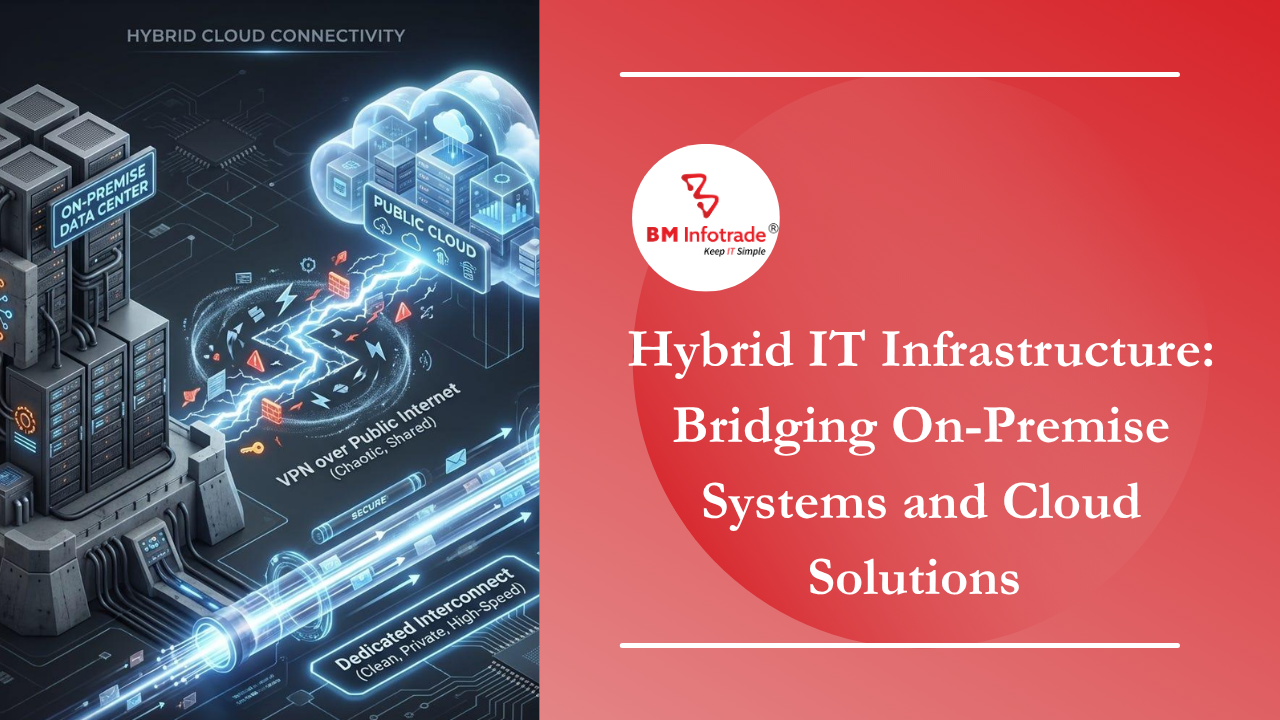
A hybrid model requires stable, secure, and reliable connectivity. Depending on the architecture involved, this may include VPN architecture, dedicated connection lines, segmented networks, access policies, and traffic management between physical data centres and cloud services.
Disparate login mechanisms and inconsistent permissioning mechanisms can result in a substantial reduction of risk. To improve visibility of identity management and access, BM Infotrade assists organisations in achieving standardised policies across both endpoints (e.g., on-premise and cloud) against the same standards.
4. Data Protection and Disaster Recovery
Hybrid IT increases the value of backup and recovery solutions. Cloud-based backup, replication, failover, and disaster recovery solutions can help organisations protect their on-premise systems and eliminate or reduce downtime caused by disasters.
5. Performance and Governance Optimisation
Not all workloads belong in the cloud; therefore, it is vitally important for organisations to accurately define performance thresholds, compliance requirements, cost limitations, and governance rules to achieve an efficient, scalable hybrid IT infrastructure over time.
Traditional Method vs. Our IT Solution
|
Area
|
Traditional Method
|
Our IT Solution by BM Infotrade
|
|
Infrastructure Model |
Fully on-premise or loosely connected cloud tools |
Unified hybrid IT architecture with planned workload placement |
|
Scalability |
Hardware-bound expansion with long procurement cycles |
Elastic Cloud supports being layered onto stable on-premise systems |
|
Disaster Recovery |
Manual backups and limited failover capability |
Cloud-enabled backup, replication, and recovery planning |
|
Security |
Separate controls across systems, limited visibility |
Integrated policy-driven security across on-premise and cloud |
|
Access Management |
Multiple credentials and inconsistent permissions |
Centralised identity alignment and controlled user access |
|
Cost Control |
High capital expense with underused infrastructure |
Balanced CapEx and OpEx with workload-based resource planning |
|
Business Continuity |
Greater risk during outages or hardware failures |
Resilient architecture designed for uptime and recovery |
|
Innovation Speed |
Slow rollout of new applications and services |
Faster deployment using cloud-ready environments and automation |
Reference Hybrid IT Architecture
1. Core Architecture Components
An effective hybrid IT architecture generally comprises on-premises servers, storage resources, firewalls, virtualisation, cloud computing, cloud storage, backup, identity management, monitoring, and secure connectivity. All parts of the architecture must promote visibility, governance and resilience across both parts of the architecture.
2. On-Premise Layer
This layer of the architecture consists of legacy systems, core databases, production systems, internal file servers and workloads that require local processing or have strict compliance obligations.
3. Cloud Extension Layer
This layer of the architecture consists of flexible computing resources, secondary storage, backup repositories, DR targets, analytic services, development environments and current applications that can benefit from elasticity.
4. Security and Identity Layer
This layer of the architecture ensures that user authentication, access control, endpoint security, encryption, logging and policy enforcement are consistent regardless of where the workload resides.
5. Monitoring and Management Layer
A hybrid environment must be continuously monitored. Central management CPM is necessary for all aspects of performance monitoring, usage visibility, patch governance, capacity planning and incident response.
The best architectures should not be complex but rather have a clear purpose for each component, have a defined security posture and have an operational owner for each component.
Implementation Roadmap for Hybrid IT Infrastructure
Phase 1: Discovery and Business Alignment
The initial phase includes determining the inventory of the infrastructure, how critical each workload is, what compliance requirements exist, how users access the systems, how the systems perform as per expectations and also identifying any operational challenges. BM Infotrade will determine what systems will remain in the on-premises environment versus which systems could be migrated to a cloud-computing service platform, and which systems will need to be redeveloped and redesigned. IoT is the phone.
Phase 2: Architecture Design
The hybrid model is also developed during this phase for networking, applications, storage, identity and security. Additionally, an aligned business case must also be established during this phase, so that leadership can understand operational benefits, risk mitigation, cost direction, and implementation priorities.
Phase 3: Pilot Deployment
A controlled environment testing (pilot) is critical for successful deployment. Rather than moving all of your assets or workloads at once, validate and verify one environment or workload family or business function by moving to the cloud now, so that you can validate and verify your system’s functionality. This will mitigate the risk of migration and allow for early identification of any integration issues.
Phase 4: Security Hardening and Governance
Before conducting a full-scale rollout of the hybrid IT environment, security control measures must be aligned. This includes access controls, encryption methods and procedures, backup validation, disaster recovery procedures, device trust policy, and monitoring dashboards.
Phase 5: Migration and Integration
After workloads have been moved, connected or extended per the roadmap, operational teams will need to create documentation, role clarity and support processes.
Phase 6: Optimisation and Future Expansion
Once infrastructure has been deployed, it must be assessed for cost efficiencies, performance, resource consumption, and policy compliance. Note that Hybrid IT is an evolving operational model, not a “one-and-done” project.
Business Benefits of Hybrid IT Infrastructure
1. Protects Existing Investments
To modernise, businesses do not necessarily need to replace every server, every application or every process; instead, they can leverage Hybrid IT, which allows organisations to continue getting value from their existing infrastructure while building out a more agile future.
2. Improves Operational Flexibility
Applications can be placed where they will run best, with backup and testing in the cloud, while critical workloads will continue to run on-premises, providing leadership with more options and flexibility without additional disruption.
3. Strengthens Resilience
A properly designed hybrid model enhances recovery readiness by providing data replication and off-site backup solutions as well as cloud-based recovery environments, which help reduce the impact of outages and hardware failures.
4. Supports Compliance and Control
Organisations can keep sensitive systems on-premises when appropriate and move less sensitive systems and/or highly scalable workloads to approved cloud-based solutions, giving organisations greater control over the location and access to their data.
5. Accelerates Innovation
Development teams, analytics teams and business units can deploy applications faster when cloud resources are made available on demand. Hybrid infrastructure provides an opportunity for innovation without having to tear down successful existing systems.
How BM Infotrade Adds Strategic Value
BM Infotrade goes beyond simply pushing the cloud-first message; it also offers an infrastructure strategy that is business-fit. This is significant as many organisations fail to transform due to making technology decisions based on trends rather than on how the architecture will impact their future.
Our technology team has identified that customers require more than just support for deploying their services; they also need a partner who understands workload behaviour and the associated security risks, as well as their uptime expectations, vendor ecosystems and the realities of operating in a mixed environment. BM Infotrade has an engineering approach to hybrid IT planning and implementation.
BM Infotrade also provides architecture consultations, infrastructure assessments, security-first designs, integration planning, migration assistance, monitoring strategies and continual optimisation. For businesses looking for reliability without sacrificing agility, BM Infotrade is a reliable and trustworthy partner providing solutions.
How to Future-Proof the Business with Hybrid IT
To future-proof an organisation does not mean being able to foresee every technology change; rather, it is about creating an infrastructure that can adapt as the world evolves. A well-designed hybrid IT environment can do just this.
Organisations need to develop policies and implement specific procedures to provide consistency for their security, develop applications that can run in the cloud today and the future, adopt scalable models for backing up data, implement strong organisational identity governance, implement visibility into their infrastructure, and have a vendor-agnostic plan. In addition, they should never lock their critical business continuity into one platform without having a backup plan.
The studies show that organisations that utilise hybrid IT as a strategic architecture layer instead of a transitional state have a greater ability to grow, acquire, work remotely, adopt analytics, and become more mature in terms of security.
BM Infotrade's long-term vision is straightforward: to help organisations create an IT infrastructure that supports the performance needs of today and the needs of tomorrow for flexible operations.
Success Checklist
-
1. Perform an audit of the existing on-site hardware and software and their interdependencies.
-
2. Sort out different workloads based on their security, compliance, speed of response and scalability requirements.
-
3. Decide which applications are best suited to remain on-site versus those best suited to being migrated or extended to the Cloud.
-
4. Establish secure connectivity between the cloud and an organisation's physical environment.
-
5. Standardise identity and access policies across all platforms.
-
6. Establish backup, replication and disaster recovery policies and procedures.
-
7. Establish a performance measurement and monitoring plan.
-
8. Periodically test the business continuity plan and business continuity scenarios.
-
9. Perform regular review of cloud vs on-premise costs.
-
10.Work with a reliable hybrid infrastructure partner such as BM Infotrade.
Conclusion
Hybrid IT infrastructure is not simply selecting either "old" technologies, like those in-house or "new" cloud-based applications, but rather, it is combining an organisation's existing stable in-house systems with newer cloud-based solutions to create the most effective business outcome for the organisation.
Organisations that have established valuable in-house systems and are also building on their cloud demand will benefit from this uniquely secure and scalable hybrid infrastructure.
The real value for organisations adopting a hybrid IT model comes from the unified design of their technical architecture, governed by excellence of technical competency, governance and business alignment. BM Infotrade is a company that delivers the greatest value to organisations that are building hybrid IT models because they intelligently help organisations integrate their in-house infrastructures with the new cloud.
Call to Action
If your organisation is preparing to modernise your infrastructure without interruption to mission-critical operations, BM Infotrade can assist you to design an effective hybrid IT Strategy for security, performance and scalability. Please contact BM Infotrade for a consultation or request a white paper from BM Infotrade to analyse how a well-designed hybrid IT environment can help to mitigate risk and improve operational performance.
FAQs
1. What is a hybrid IT infrastructure in simple terms?
A hybrid IT infrastructure is a setup where a business uses both on-premise systems and cloud solutions together, instead of depending only on one environment.
2. Why do businesses choose hybrid IT instead of full cloud migration?
Many businesses still rely on legacy applications, compliance-sensitive data, or low-latency systems that work better on-premise. Hybrid IT lets them modernise without forcing a complete move.
3. Is a hybrid IT infrastructure secure?
Yes, it can be highly secure when designed properly. Security depends on strong identity controls, encryption, network segmentation, monitoring, and consistent policies across both environments.
4. How does BM Infotrade help with hybrid IT infrastructure?
BM Infotrade helps businesses assess their current systems, design the right hybrid architecture, connect on-premise and cloud environments securely, and support implementation and optimisation.
5. Which industries benefit most from a hybrid IT infrastructure?
Manufacturing, finance, healthcare, retail, logistics, and any sector with legacy systems, compliance requirements, or business-critical applications can benefit strongly from hybrid IT.



Anshul Goyal
Group BDM at B M Infotrade | 11+ years Experience | Business Consultancy | Providing solutions in Cyber Security, Data Analytics, Cloud Computing, Digitization, Data and AI | IT Sales Leader