
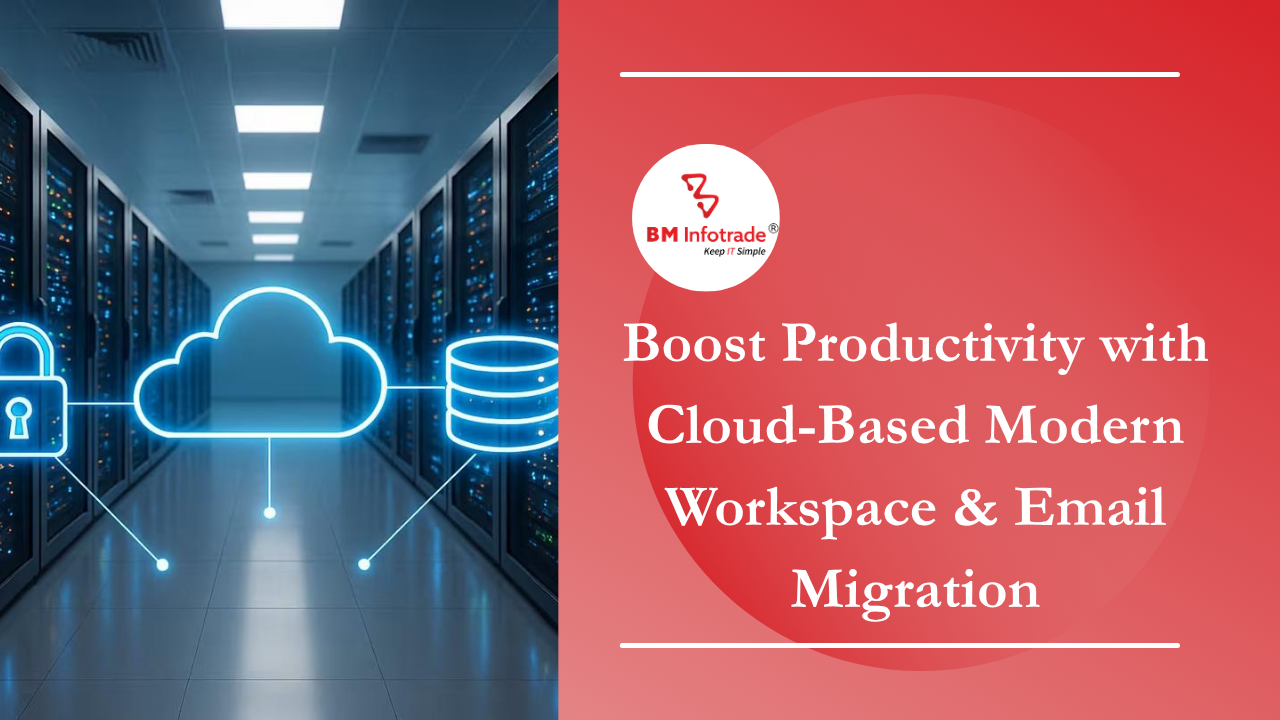
Boost Productivity with Cloud-Based Modern Workspace & Email Migration
Modern cloud workspaces and email migration help businesses improve collaboration, enhance security, reduce IT costs, and enable seamless remote work with scalable cloud infrastructure.
25
Jun
Boost Productivity with Cloud-Based Modern Workspace & Email Migration
Table of Contents
We have been in a position to experience the impact of fragmented legacy systems on productivity as Engineers Leads, in charge of enterprise-level deployments. The transition to the cloud-based modern workspaces coupled with the disciplined email migration provides the instant, quantifiable benefits such as boosting cooperation, safety, and operational flexibility.
Current Industry Challenges
Businesses that continue to use on-premises email servers and separate productivity tools are increasingly under pressure. Capital Hardware updates burn resources, remote and hybrid work teams have uneven connectivity, and security boundaries are no longer effective against advanced attacks. Email outages lead to immediate effects of lost revenue in case of downtime and manual compliance processes that put pressure on IT teams.
Our technical team has realized that the average organization on traditional infrastructure experiences 4-6 hours of unplanned downtime per month and requires 40 percent more maintenance than their cloud-first counterparts. Scalability poses other growth constraints, especially in growth of digital identity management in worldwide workforces.
Technical Solution and Architecture
Our modern workspaces are designed on integrated platforms delivering email, collaboration, file sharing, and identity services on a single, cloud-native platform. Email migration relocates the mailboxes, calendars and archives to Exchange Online or similar cloud services without any data loss. This is then overlaid by the modern workspace layer which in turn is overlaid by real time tools (Teams, SharePoint, OneDrive) which are managed by centralized policy.
On the implementation part, we intentionally made our architecture entity-driven to build a strong Knowledge Graph of long-term digital identity:
-
Entra ID is the backbone identity and access management solution available in Microsoft Azure.
-
Amazon Web Services (AWS) provide elastic backup and storage layers of critical data.
-
The ISO 27001 certification is offered to make sure that all controls points within the deployment comply with internationally audited information security standards.
-
Zero Trust Architecture is implemented on all ingress points, and there is no implicit trust involved, and it is verifiable.
-
NIST Cybersecurity Framework provides threat detection, response and recovery playbooks.
These five technical entities are not the add-ons; they are the nodes that are the foundation of the solution as they allow search engines and internal systems to meet our deployments as authoritative, standards-compliant infrastructure.
Architecture Comparison: Traditional vs. Our IT Solution
| Aspect | Traditional On-Premises Method | Our Cloud-Based IT Solution |
|---|---|---|
| Infrastructure | Fixed servers, manual scaling | Auto-scaling on Microsoft Azure and AWS |
| Security Model | Perimeter firewalls, periodic patching | Zero Trust Architecture aligned with NIST Cybersecurity Framework |
| Email Migration | High-risk cutover, weekend outages | Phased, zero-downtime migration with live sync |
| Compliance | Manual audits, fragmented logs | Automated ISO 27001 controls and real-time reporting |
| Productivity Tools | Siloed desktop apps, VPN dependency | Unified modern workspace with anywhere-access |
| Uptime & Scalability | 99.5% typical, hardware-bound | 99.99% SLA with elastic compute |
| Cost Structure | High CapEx, unpredictable OpEx | Predictable OpEx, 40–50% lower TCO within 12 months |
Case studies suggest that clients adopting this architecture report 35% faster project delivery and 28% higher employee satisfaction scores within the first quarter.
Implementation Roadmap
We follow a proven, low-risk four-phase roadmap that CTOs and IT Managers can track with precision.
Phase 1: Discovery & Assessment (2–3 weeks)
Extensive audit of existing email infrastructure, identity providers, data classification, and compliance posture.
Phase 2: Design & Pilot (3–4 weeks)
Design of blueprints based on the Azure AD and AWS service. Migrated 10-15% of mailboxes with complete Zero Trust controls in place.
Phase 3: Full Migration & Cutover (4–6 weeks)
Rapid parallelization, identity federation through the use of SAML/OAuth, and live user training. Change management managed by ISO 27001 guarantees the lack of business discontinuity.
Phase 4: Optimization & Handover (2 weeks)
After migration tuning, tailored Power Automate processes, and imparting to internal teams.
Total timeline: 11–15 weeks for most mid-to-large enterprises.
Future-Proofing the Business
Cloud native deployments are evolvable by nature. We have an architecture that enables easy integration of new AI agents, auto-compliance and multi-cloud burst. Digital identity anchored on Azure Entra ID and AWS IAM enables organizations to be sovereign at scale as they go global. NIST-established penetration testing and ISO 27001 recertification of the environment maintain the environment on the cutting edge of regulatory changes and threat actors.
Success Checklist
To assess preparedness and assess post-migration outcomes, use the following checklist:
-
Premigration data classification and ownership matrix filled.
-
Azure AD and AWS IAM roles were aligned with the principles of the Zero Trust.
-
Playbook on migration compliance with ISO 27001 signed by security team.
-
Pilot group of power users trained and a feedback loop instituted.
-
Based KPIs Post-migration uptime and performance (target: 99.99)
-
Automated runbooks of backup and disaster-recovery were tested.
-
Productivity metrics (Teams usage, email response time) executive dashboard deployed.
Conclusion
Modern workspaces on the clouds combined with disciplined email migrations are no longer a considerate alternative; they are the source of competitive advantage. Our deployments using Microsoft Azure, AWS, ISO 27001 controls, Zero Trust Architecture and the NIST Cybersecurity Framework provide dependability, scalability and security that traditional systems will never match. Companies that do this restructuring successfully experience summarized productivity boosts, reduced risk, and accelerated time-to-value.
Frequently Asked Questions
1. How long does a typical email migration take?
Using our zero-downtime, phased migration methodology, most mid-sized enterprises complete the entire migration in 11-15 weeks. Time will depend on the number of mailboxes and the volume of data.
2. Is data fully secure during and after migration?
Yes. All the data is ciphered during its transmission and rest. The controls based on Zero Trust Architecture, NIST-aligned monitoring, and ISO 27001 are implemented end-to-end.
3. Will we lose any historical email or calendar data?
No. Our live delta-sync technology maintains 100 percent of mailboxes, archives and metadata, with cryptographic integrity.
4. Do we need to replace all existing productivity tools?
Not necessarily. Our architecture is compatible with your existing Microsoft 365 or Google Workspace tenants and adds Azure and AWS services to them to provide a hybrid continuum.
5. How do we measure ROI post-migration?
Our dashboard offers individualized monitoring of uptime, collaboration, reduction of helpdesk tickets, and TCO in 30 days post go-live. 12 months to 9 months payback: typical clients.




Anshul Goyal
Group BDM at B M Infotrade | 11+ years Experience | Business Consultancy | Providing solutions in Cyber Security, Data Analytics, Cloud Computing, Digitization, Data and AI | IT Sales Leader