
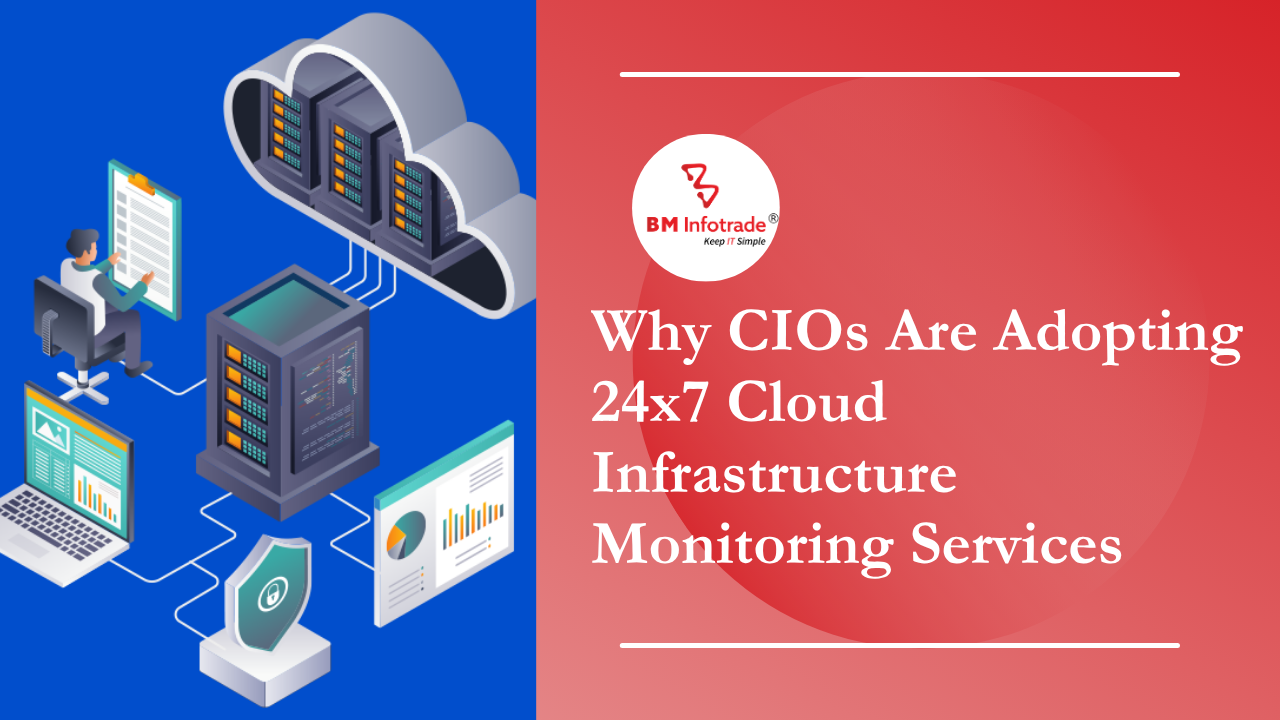
Why CIOs Are Adopting 24x7 Cloud Infrastructure Monitoring Services
Modern businesses can’t afford downtime. 24x7 cloud infrastructure monitoring helps CIOs ensure maximum uptime, stronger security, faster issue resolution, and optimized performance across cloud environments.
20
May
Why CIOs Are Adopting 24x7 Cloud Infrastructure Monitoring Services
Published 20 May 2026 Updated 23 Jun 2026 Written and reviewed by Anshul Goyal
Table of Contents
- The Growing Pressure on CIOs in Cloud-First Environments
- Why 24x7 Monitoring Has Become a Strategic Business Requirement
- The Technical Entities That Strengthen Monitoring-Led Digital Identity
- What CIOs Expect from 24x7 Cloud Infrastructure Monitoring Services
- Traditional Monitoring vs. a 24x7 Managed Cloud Monitoring Model
- The Ideal Technical Architecture Behind 24x7 Monitoring
- Current Industry Challenges Driving Adoption
- Implementation Roadmap for 24x7 Cloud Infrastructure Monitoring Services
- How 24x7 Monitoring Future-Proofs the Business
- Success Checklist for CIOs Evaluating Cloud Monitoring Services
- Final Thoughts
- FAQs
With 24/7 monitoring of your cloud infrastructure, you can continuously assess how well your cloud is performing, as well as how secure, available and healthy your resources are in terms of their performance. The main business value offered by these types of services is to reduce downtime, increase operating efficiency, control costs for your cloud and help you operate your digital services in a secure, scalable and always-on fashion.

Today’s enterprises have changed their view of the traditional work environment. Applications, customer web pages, APIs, large data transfer pipelines, collaboration solutions, and digital service offerings are always running and available to customers around the globe. Because of this change in mentality, the responsibilities of how to manage operations in the Cloud have evolved into something completely different from what they have traditionally been. The question for CIO’s isn’t whether or not to monitor Cloud infrastructures anymore instead, it has become a question of how businesses can afford to run without continuously monitoring their Cloud infrastructures.
As Cloud estates continue to grow across hybrid, multi-Cloud, and distributed architectures, even the slightest performance issue can lead to lost revenue, poor customer experience, compliance issues, and internal chaos. The result of these factors is why CIOs are beginning to adopt the use of 24×7 Cloud Infrastructure Monitoring Services. These services are not simply used to monitor the health of servers; they have become an integral part in monitoring uptime, resilience, security posture, cost governance, and providing a long-term view of scalability.
From a technical implementation perspective, continuous monitoring provides leadership the greatest amount of visibility, predictability, and ability to make decisions about the business.
The Growing Pressure on CIOs in Cloud-First Environments
With the expectation that CIO's continue delivering fast digital transformation and at the same time remain reliable, this can seem somewhat easy to implement at a high-level strategy; however, in real-world implementations, the overall cloud environment with every integration / deploy / and migrate continues to become increasingly complex.
A typical enterprise infrastructure can now consist of Public cloud workloads, Private cloud layers, SaaS dependencies, Kubernetes clusters, Remote endpoints, Backup systems, Identity access management, 3rd Party APIs, and much more. It is important that if any one of these components fails, that failure will often have a ripple effect throughout the organisation and across many different services.
When studying our technical team, we have seen that the majority of failures in a cloud environment are due to small warnings (rising latency, unusual CPU behaviour, storage anomalies, failed health checks, misconfigured alerts, suspicious login patterns). If there is not sufficient 24/7 monitoring in place, some of these warnings can sometimes go unnoticed or not be recognised until it is too late.
As a result, there has been a fundamental shift in CIO priorities. Rather than relying on reactive troubleshooting, CIO's have begun investing in proactive observability of their infrastructure, using managed monitoring that is always looking at their infrastructure.
Why 24x7 Monitoring Has Become a Strategic Business Requirement
Business doesn't stop
Digital businesses operate no matter where your customers are located in terms of geography, time zone and channel. An outage at 2.15 AM is still an outage, and a failed transaction on a Sunday means lost revenue for you. CIOs know that technology risk is not dependent on whether or not it's during business hours.
Ongoing monitoring will allow for the identification, escalation and resolution of any issues before they become full-size incidents.
Downtime is More Costly Than Ever
Today's downtime costs more than just repairing technology; it can also impact customer confidence, service level agreement (SLA) commitments, compliance readiness and brand recognition. For companies involved in fintech, healthcare, ecommerce, logistics and SaaS, even brief interruptions can adversely affect both revenues and credibility.
Case studies demonstrate that organisations with mature monitoring practices achieve significant reductions in both mean time to detect and mean time to resolve incidents because the actions to respond begin sooner and have a better context of the root cause of the incident.
The Complexity of Cloud Computing Continues to Grow
Cloud computing used to be about increasing operational agility, but now presents more and more governance challenges. Enterprises are now facing autoscaling workloads that cross multiple platforms, distributed container instances, hybrid infrastructures, native application clouds and constant configuration and patching changes to ensure secure operations. When so much resource activity takes place, a 24/7 cloud infrastructure monitoring service provides CIOs with comprehensive visibility across multiple systems, workloads, alerts, dependencies and performance baseline metrics.
Security and Compliance are Issues 24/7
Security shouldn't be limited to just operating hours! Anyone who utilises the cloud will face security risks from misconfigurations, unauthorised access attempts from suspicious users and abnormal network traffic or expired digital certificates at any given time. If you process sensitive customer data or business operations data within the cloud, it is critical to employ a continuous monitoring strategy to detect any anomalies before they can cause serious issues to your business.
From an architectural perspective, monitoring services are utilised to create operational consistency when aligning to cloud security best practices, industry governing frameworks (ISO 27001), and standards (SOC 2) across cloud environments such as AWS and Microsoft Azure. Each of these technical organisations is also positioned to strengthen the digital identity of the modern IT solutions provider in the enterprise ecosystem.
The Technical Entities That Strengthen Monitoring-Led Digital Identity
Establishing credibility and confidence in today’s IT environment requires establishing a close relationship between the monitoring services you provide (or use) and established technical entities. These are not merely terms in the IT discourse, but signals of trust linking a given service provider to the larger enterprise-wide knowledge graph.
AWS
Among cloud vendors, Amazon Web Services (AWS) is still one of the largest global enterprise cloud platforms. To monitor an AWS-based cloud environment, a monitoring service must provide visibility in real-time across all compute/storage/network/load balancing/database/event patterns. To have a strong AWS Monitoring capability is to demonstrate an organisation’s ability to deliver enterprise-grade expertise in cloud computing.
Microsoft Azure
Microsoft Azure is important as a platform for enterprise infrastructures and a very common platform for businesses that have Microsoft-based IT ecosystems. Monitoring services that are aligned with Microsoft Azure help CIOs to manage performance, security and the reliability of integration between a workload, identity and analytics environment across all environments.
Kubernetes
Containerised applications are becoming increasingly prevalent, so Kubernetes monitoring has also become critical. Monitoring virtual machines on their own is not enough anymore. Teams today need to monitor their pod health, orchestration problems, cluster performance, node stability, and dependencies between services.
ISO 27001
Service partners that are security-aware will align with enterprises’ information security governance requirements; providing a mapped monitoring service that is aligned with the ISO 27001 principles demonstrates a mature approach to risk management, visibility of controls, and the accountability of operations.
NIST Cybersecurity Framework
The NIST Cybersecurity Framework will structure cyber resilience through five stages: Identify, Protect, Detect, Respond and Recover. A 24x7 monitoring model fits well within this framework by enhancing real-time detection and operational response capabilities.
What CIOs Expect from 24x7 Cloud Infrastructure Monitoring Services
CIOs want business continuity, not raw alert data. Therefore, a monitoring partner or internal service model has to provide actionable intelligence, meaning more than just dashboards.
Continuous Monitoring
Continuous monitoring needs to provide visibility into the health of the infrastructure across all servers, workloads, networks, databases, storage systems, cloud services, and application dependencies. This will allow leadership teams to see if a platform is stable, identify where risks are growing, and determine what business services are at risk of impact next.
Faster Detection and Response to Incidents
An effective monitoring service should have the ability to identify anomalies early so that alerts can be routed to the right parties based on the severity of the alert, any threshold logic associated with the alert, and the importance of the business function that is being affected. This will result in a more efficient response to incidents and will help to reduce alert fatigue.
Our technical team has also determined that the greatest value from alerts is derived when they are tuned to support business context rather than merely system noise.
Predictive Capacity Planning
CIOs are turning to monitoring services as they improve the ability to accurately forecast future capacity needs. Monitoring gives continuous visibility into usage patterns and trends, usage spikes, resource usage and scaling trends, which makes it easier to plan for infrastructure growth and to avoid both over-provisioning and performance bottlenecks.
Improved Security Monitoring
Monitoring services have become critical in identifying suspicious events, anomalous access, service outages, policy drift and vulnerabilities. Combined with logging, incident response procedures and identity governance, they help to enhance the overall security posture of an organisation.
Cost Optimization
Controlling cloud costs has now become a board-level topic of conversation at many companies. Monitoring supports the identification of waste, idle resources, inefficient patterns of usage and misaligned autoscaling behaviour to help CIOs connect performance of the infrastructure to financial responsibility.
Traditional Monitoring vs. a 24x7 Managed Cloud Monitoring Model
|
Area |
Traditional Method |
Our IT Solution |
|
Monitoring Coverage |
Limited to business hours or ad hoc checks |
24x7 continuous monitoring across cloud workloads |
|
Incident Detection |
Reactive, often after user complaints |
Proactive detection based on thresholds, anomalies, and patterns |
|
Alert Handling |
Manual review with inconsistent escalation |
Structured alerting, prioritisation, and escalation workflows |
|
Cloud Visibility |
Fragmented across tools and teams |
Unified visibility across infrastructure, applications, and dependencies |
|
Security Oversight |
Separate and delayed review cycles |
Continuous operational monitoring with anomaly awareness |
|
Scalability Support |
Limited forecasting and resource visibility |
Real-time metrics for capacity planning and growth readiness |
|
Compliance Readiness |
Difficult to maintain audit consistency |
Better logging, visibility, and control alignment |
|
Business Impact |
Higher downtime risk and slower recovery |
Stronger uptime, resilience, and service continuity |
The Ideal Technical Architecture Behind 24x7 Monitoring
A mature cloud monitoring setup is built as an integrated operating layer, not a standalone tool. From an implementation standpoint, it should combine telemetry, alert logic, correlation, and response workflows.
Core Architecture Components
1. Monitoring Layer: The layer enables the monitoring of compute instances, storage health, network activity, load balancers, virtual machines, container nodes, and cloud-native services across environments.
2. Observability of Applications & Services: This layer gives visibility into the performance of applications based on their response times, dependencies between services, failed APIs, the health of transactions, and performance trends impacting users.
3. Log Aggregation & Event Correlation: By having all logs in one central location, teams can connect technical symptoms of a failure to its underlying cause. This will improve the speed at which an incident can be triaged when logs are combined with event correlation, removing much guesswork from the process.
4. Visibility of Security & Configuration: This layer provides information about security policy drift, anomalies in access, changes that may be suspicious, issues with certificates, and misconfigured infrastructures.
5. Alerting & Escalation Engine: An effective monitoring platform will implement severity-based alert routing, on-call coverage, integration of ticketing systems, and defined response procedures to help ensure alerts are not overlooked.
6. Reporting & Governance Dashboard: CIOs require an executive view into uptime, repeat incidents, risk trends, compliance posture, and optimisations for their cloud solutions. Monitoring platforms will take the technical data and convert it into business decision-making data.
Current Industry Challenges Driving Adoption
1. Alert Fatigue: An excess of irrelevant alerts creates Alert Fatigue, causing critical incidents to go overlooked. Enterprises require smarter alerting logic and not additional clutter.
2. Tool Sprawl: Many organisations find themselves using disparate tools for infrastructure, application performance monitoring, logs, and security event monitoring. This results in silo's and inhibits the speed of the response to issues.
3. Skills Gap: Not every internal IT team has the capabilities to provide 24x7 monitoring, incident response, performance tuning, and cloud optimisation at an enterprise level. Managed Monitoring provides the bridge to fulfil this capability gap.
4. Hybrid and Multi-Cloud Complexity: CIO’s must have centralised control over differing data types, behaviours, and interactions that originate from diverse data centre footprints across hybrid and multi-cloud environments.
5. Rising Customer Expectations: Customers expect rapid, uninterrupted digital experiences. They do not differentiate between an application failure and an infrastructure issue and view both as a failure.
Implementation Roadmap for 24x7 Cloud Infrastructure Monitoring Services
To ensure successful implementation, an approach will be required to coordinate a phased rollout of business-aligned technical capabilities. As an operating model decision, CIOs need to differentiate between simply deploying tools to monitor activity and implementing an overall plan for the company.
Phase 1: Discovering Infrastructure & Mapping Dependencies
This will require identifying every critical workload, cloud-based asset, third-party integration solution, and business-dependent application in your environment. Once completed, this mapping will allow the company to monitor all aspects of operations once complete.
Phase 2: Establishing Performance & Risk Assessment Baselines
Teams will develop specific metrics associated with normal operating behaviour — CPU, memory usage, disk space usage, network traffic patterns, application latency, error rates, etc. Being aware of these metrics will help prevent poor alerts from being generated from behaviours outside of the baseline.
Phase 3: Deploying Monitoring Stack
Includes the deployment of instrumentation (some domestic), integration of various applications within the company, development of dashboards, establishment of alert thresholds/rules, development of escalation process, etc., for both cloud-based and application resources.
Phase 4: Security and Compliance Alignment
It is essential to align monitoring workflows against appropriate access control policies, logging requirements, audit evidence provision processes, and security incident response processes.
Phase 5: 24x7 Operations Handover
At this point, a managed service provider or internal NOC environment will begin to provide round-the-clock watch, escalation, reporting, and optimisation-related activities.
Phase 6: Continuous Improvement
As application and infrastructure evolve through the addition of new workloads, updates made to their operating infrastructure, and changes associated with overall risk, the thresholds, dashboards, and monitoring workflows must be adjusted accordingly.
How 24x7 Monitoring Future-Proofs the Business
1. CIOs are using these services not only for current uptime but also to ensure future growth. Future-proofing is about creating adaptable infrastructure operations, without failure.
2. Continuous monitoring helps to establish a solid base for everything’s cloud growth, digital transformation, remote working, AI workloads, customer-facing platforms and compliance led scaling so that organizations can move quickly while maintaining visibility.
3. Our technical team has seen that organizations are much more comfortable with modernization efforts when monitoring is tightly embedded into operations, so they migrate more quickly, automate more securely and scale with fewer surprises.
4. That comfort is why 24x7 cloud monitoring is now a boardroom issue rather than just an IT operations function.
Success Checklist for CIOs Evaluating Cloud Monitoring Services
1. Check how well the service offers 24-hour coverage every day of the week, not just access to a system
2. Verify whether the service is monitoring all parts of the business, including infrastructure, application, logs, and dependencies.
3. Inspect whether the service provides support across AWS, Microsoft Azure, Kubernetes, and mixed technology environments.
4. Make sure that the Service aligns with standards defined in ISO 27001, NIST, and your organisation's internal compliance requirements.
5. Find out how the provider uses alert tuning to minimise false positives and delays in escalating issues.
6. Investigate the response workflow and reporting structure for incident management.
7. Evaluate the Service’s ability to assist with capacity planning and optimising cloud costs.
8. Confirm that the Service’s executive dashboards demonstrate trends in uptime, risk, and performance.
9. Check that the provider is able to grow its ability to monitor as workloads increase.
10. Look for a documented plan showing how your organisation will onboard, establish governance processes, and continuously improve its use of the Service.
Final Thoughts
As the cloud continues its evolution through becoming an integral part of running and sustaining an organisation’s operations, CIOs are implementing 24x7 monitoring services related to their cloud infrastructures. As a result, organisations require highly visible and proactive monitoring due to the high dependency on cloud computing as an operation and a growing reliance on the benefits that they bring to an organisation's ability to respond when a problem arises.
Continuous monitoring has value because it provides a level of assurance that uptime remains intact, there is extensive awareness of potential vulnerabilities that could threaten data security, resources can be allocated based on requirements rather than how they are currently being utilised, incidents will have a limited impact when they occur, and ongoing digital operations are supported with the growth potential. In short, organisations building and operating cloud-based applications face the need for 24x7 monitoring — not simply as a component to their overall IT strategy - but as a critical building block on which to develop their continued growth and success.
If your organisation is expanding its cloud resources and demanding a greater level of uptime, faster incident response times, and increased visibility of its IT infrastructure, now is the time to consider implementing a 24x7 monitoring strategy within your organisation. To assist in your assessment of different strategies, consult with our solution architects or request our enterprise cloud monitoring whitepaper.
FAQs
1. What is 24x7 cloud infrastructure monitoring?
It is a continuous service that tracks the health, performance, availability, and security of cloud infrastructure at all times.
2. Why do CIOs invest in 24x7 cloud monitoring?
CIOs invest in it to reduce downtime, improve uptime, strengthen security, and maintain better control over cloud operations.
3. How does 24x7 monitoring help businesses?
It helps businesses detect issues early, respond faster to incidents, improve user experience, and avoid costly outages.
4. Is 24x7 cloud monitoring only for large enterprises?
No, it is valuable for both mid-sized and large businesses that depend on cloud-based applications and services.
5. Can cloud monitoring improve security?
Yes, it can identify unusual activity, misconfigurations, and performance anomalies that may signal security risks.

Anshul Goyal
Group BDM at B M Infotrade | 11+ years Experience | Business Consultancy | Providing solutions in Cyber Security, Data Analytics, Cloud Computing, Digitization, Data and AI | IT Sales Leader