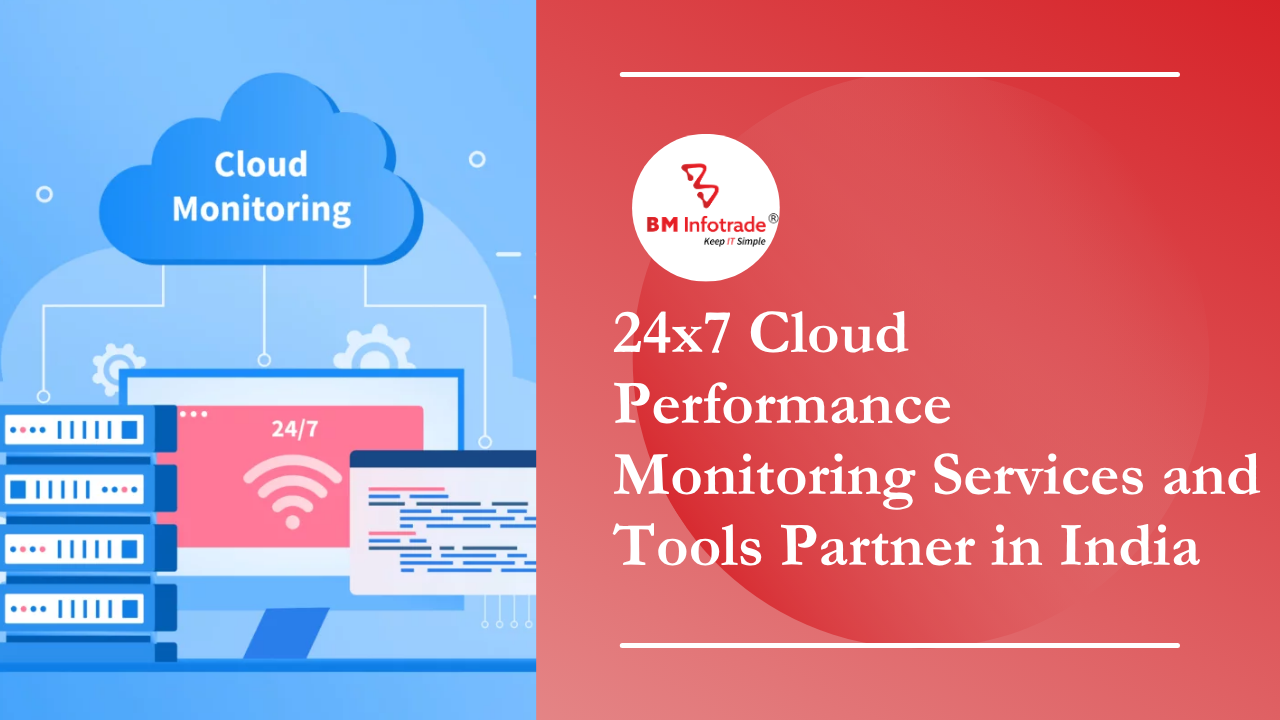
24x7 Cloud Performance Monitoring Services and Tools Partner in India
A complete guide to 24×7 cloud performance monitoring services in India, covering top tools, observability, cost optimization, and multi-cloud strategies for 2026.
04
Apr
24x7 Cloud Performance Monitoring Services and Tools Partner in India
Published 04 Apr 2026 Updated 26 Jun 2026 Written and reviewed by Anshul Goyal
As we move towards 2026, companies will require more than just graphs or alerts for their cloud monitoring solutions; they will also require comprehensive visibility into their infrastructure throughout all stages of an incident, as well as support for ongoing costs across multiple types of deployments, including Kubernetes, serverless, hybrid and multi-cloud.
The preferred approach for most companies is to leverage an extremely effective observability platform and partner with a managed, 24/7 monitoring service in India that is trained to deploy, improve, and expand monitoring as if it were a production system rather than simply a GUI interface.

What 24×7 Cloud Performance Monitoring Services Should Include
An experienced managed monitoring partner will have several key functions within their service offerings:
1. Availability of 24×7 Monitoring and Incident Resolution
Continuous monitoring and responding to customers' cloud-based infrastructure, applications and services.
Real-time alerts and the ability to filter out alerts to avoid alert fatigue.
The ability to escalate incidents and define different levels of severity.
The ability to conduct a root cause analysis and provide post-incident reports.
2. Visibility across the full stack
A mature monitoring solution should monitor the following areas:
Infrastructure monitoring (server, container, Database, Queue, storage, etc.).
Application Performance Monitoring (APM) with the ability to trace and map services.
Centralised logging to assist in debugging issues.
Synthetic monitoring to verify critical user journeys.
3. Instrumentation that is Cloud-Native
The use of open standards such as OpenTelemetry for vendor-agnostic monitoring.
The use of intelligent sampling helps control costs and minimise data overload.
4. Performance + Cost Monitoring (Integration with FinOps)
Linking performance problems with cloud costs.
Identifying spikes in costs that may occur due to a misconfigured system or a surge in traffic.
5. Correlation between Security and Performance
Integrated security monitoring that flags performance problems due to security issues.
The ability to identify misconfigurations, vulnerabilities, or unusual traffic patterns.
Best Cloud Performance Monitoring Tools in 2026
The best tool depends on how you want to use it. For example:
1. Datadog: This is great for quickly growing cloud-native businesses.
Lots of strong integrations with multiple cloud platforms.
Top-notch dashboards in real time.
Strong capability for Application Performance Management (APM) as well as infrastructure monitoring.
2. New Relic: This is the best choice for flexible pricing and easy-to-use systems.
Offers a generous free tier.
Startup and mid-sized businesses will find it simple to set up.
Strong log analytics and tracing.
3. Dynatrace: This is considered best for large enterprises.
AI-based root-cause analysis.
Automates service discovery and is designed for organisations with a hybrid of many complexities.
Equally, Kubernetes-focused businesses often use open-source stacks (such as Prometheus + Grafana + OpenTelemetry Collectors) to monitor their systems.
Datadog vs New Relic vs Dynatrace – Which is Best?
1. Setup Speed
Datadog - Easy to Set Up
New Relic - User-Friendly Design
Dynatrace - More Specialised but Works Great
2. Cost Control
Datadog - Can be Expensive as you Gain Momentum
New Relic - Pricing is More Predictable
Dynatrace - Pricing Model is enterprise-based
3. Best Fit
Fast-Growing Companies - Datadog
Budget-Conscious - New Relic
Large Business - Dynatrace
AWS vs Azure vs Google Cloud Monitoring
Native monitoring solutions exist from each Cloud provider to intuitively monitor the respective Cloud environment. Here are three examples of the native solutions;
1. Monitoring in AWS: Includes metrics, logs and alarms built into AWS and are designed to seamlessly operate with workloads built on AWS.
2. Monitoring in Azure: Provides deep integration with the entire Microsoft ecosystem (which results in great application insights and diagnostics).
3. Monitoring in Google Cloud: Allows strong analytics for data-heavy applications and provides integrated solutions specifically designed for Kubernetes environments.
Typically, for multi-cloud environments, an independent 3rd party observability tool will perform better than the native monitoring solutions.
Serverless Monitoring Tools
For serverless application Monitoring, it consists of:
Distributed Tracing between APIs & databases (i.e., cross-cutting concerns).
Tracking Cold Start performance.
Mapping Dependencies.
Infrastructure Monitoring vs APM
Tracking Errors & Analysing Transactions
1. Infrastructure Monitoring would answer:
Am I having issues with my server's uptime?
Are my CPU & Memory usage optimum?
2. Application Performance Monitoring (APM) would answer:
What is causing my application to be slow?
Which part of my application is failing?
Combining infrastructure & application monitoring provides a complete monitoring strategy.
Open-Source Cloud Monitoring for Kubernetes
The current stack of the popular open-source tools includes:
Prometheus for collecting metrics,
Grafana for creating dashboards, and
OpenTelemetry for collecting telemetry data.
With this approach, you have full control; however, it requires having a very strong internal DevOps team.
Hybrid Cloud Monitoring Best Practices
To effectively monitor hybrid environments, you will need to:
Standardise the format of all telemetry data collected.
Establish clear and defined naming conventions and tagging systems.
Monitor network performance between your on-premises and cloud environments.
Clearly define your Service Level Objectives (SLOs).
Key Features of a Cloud Observability Platform
Key Features to Look Out For:
Unified dashboards for metrics/logs/traces.
Service mapping (real-time).
Business-impact-based automated alerts.
Role-based access control.
Powerful support for Kubernetes.
Cloud Security + Performance Integration
Modern monitoring tools must correlate:
Security threats with performance problems.
Misconfigurations with slow application performance.
Unexpected traffic with system failures.
Multi-Cloud Monitoring for Enterprises
Big businesses want:
Consolidated dashboards across AWS, Azure and Google Cloud.
Single place to manage incidents.
Common tags for tracking.
Network Performance Monitoring
What will need to be watched:
DNS response times.
Loss of packets.
Latency through the API gateway.
Connection between regions.
Agentless vs Agent-Based Monitoring
1. Agent-less Monitoring
Quickly set up.
Basic View of Cloud.
2. Agent-Based Monitoring
Full and Rich Insight.
Best for APM or container monitoring in detail.
Synthetic Monitoring Tools
Synthetic Monitoring Involves So Many Real Users Affects Where You Monitor:
User login.
Shopping cart checkouts or checkout processes.
API access points.
Synthetic monitoring will find out about an issue before a real user does.
Cost of Cloud Monitoring Services
Cloud monitoring costs will vary based upon several different factors, including but not limited to:
Log Volume.
Retaining trace data.
Number of monitored servers.
Length of data retention.
Companies must develop their data retention policies to manage the associated costs.
Real-Time Cloud Server Monitoring (Free Options)
There are several affordable options available, including:
New Relic's free tier.
AWS CloudWatch Free Tier.
Prometheus & Grafana.
For businesses, it is recommended that you opt for a paid solution since they provide more reliable monitoring.
How to Choose a 24×7 Monitoring Partner in India
When looking for a monitoring partner, look for the following criteria:
Has SLO-based monitoring.
Offers OpenTelemetry Support.
Helps to optimise your costs.
Provides multi-cloud support.
Provides measurable results such as a reduced amount of downtime.
Conclusion
Monitoring performance across the cloud in 2026 is not an option; it has become an essential component of doing business. As cloud, Kubernetes, serverless and multi-cloud usage continue to increase, real-time visibility, proactive incident detection and cost-sensitive observability are all critical for organisations. The establishment of a solid, reliable 24×7 monitoring partner and an effective set of tools will help reduce downtime, improve user experience and optimise cloud costs. By selecting a suitable platform and strategy now, organisations will be well-positioned to have reliable, scalable and operational resiliency well into the future.
FAQs
Q1. What is 24×7 cloud performance monitoring?
Real-time monitoring tracks all components of the cloud environment, including applications, infrastructure & networking, to identify problems before users are affected.
Q2. Why do businesses need cloud monitoring?
Prevention of downtime, higher performance, better security, and management of cloud costs are the outcomes of this type of monitoring.
Q3. Which tools are best for cloud monitoring?
Some commonly used platforms are Datadog, New Relic, Dynatrace, Prometheus, Grafana, AWS CloudWatch, and Azure Monitor.
Q4. What is the difference between infrastructure monitoring and APM?
Monitoring infrastructure includes checking servers and resources, while APM will assess and provide feedback on application performance as well as end-user experience.
Q5. Can cloud monitoring reduce costs?
Absolutely, This monitoring method provides insight into wastefulness, inefficiencies in performance, and redundant use of resources.

Anshul Goyal
Group BDM at B M Infotrade | 11+ years Experience | Business Consultancy | Providing solutions in Cyber Security, Data Analytics, Cloud Computing, Digitization, Data and AI | IT Sales Leader